Your stomach begins to growl after hours on the road, so you ride up to the vanguard and suggest to stop for lunch. The fellowship halts in the shade of a maple grove. While Sulat sets out bread and dried peaches, you lead the horses to drink from a pond full of gigantic lily-pads.
As they bow their necks, an icy web spreads through your abdomen. Your body has already noticed the danger, and begun to freeze. Only then do you spot the bulbous yellow eyes watching you from below the surface. Water rills from the monster's calloused back as it rises. A toad—large as a shed. Its tongue lashes out and folds around your horse. The monster's flesh muffles the whinnying of your mount as she slides down its gullet.
Tutorializing Movement
I'm playing D&D 5.5 with a group of relatively inexperienced players. They like the idea of epic tactical fights but they're unfamiliar with the intricacies of the game's combat—that means it's tutorial time! My goal for the upcoming session is to teach advanced movement, so I wanted a fight that does two things:
1.Push the players to get somewhere within a limited amount of turns.
2.Take place in an arena that makes it impossible to arrive on time if you just use your standard 30 feet of movement. The players need to avoid difficult terrain, dash, and preferably use abilities like Misty Step.
To achieve both, we're going to build an encounter that involves racing the enemies. This does both [1] and [2] while having the advantage of a third function:
3.Allow for clever strategies that involve impeding the enemy's movement—not just boosting your own.
Let's draw inspiration from one of my favourite low-level monsters: the Giant Toad. This creature has a swallow attack that allows it to restrain someone inside its stomach and deal damage to them every turn. Let's say that it eats someone's horse—in your campaign it could be a beloved NPC—and then jumps around the battlefield to avoid the players.
Win condition: The toad is dead.
Lose condition: The toad survives for three rounds after eating the horse. The horse has now died and been digested. The toad barfs up its skeleton to show the players that there's no point in fighting on, then flees into the water.
The Arena
Toads and frogs are supposed to be good at jumping, so we need to build an arena that takes advantage of that. This is what the lily-pads from the intro are for!
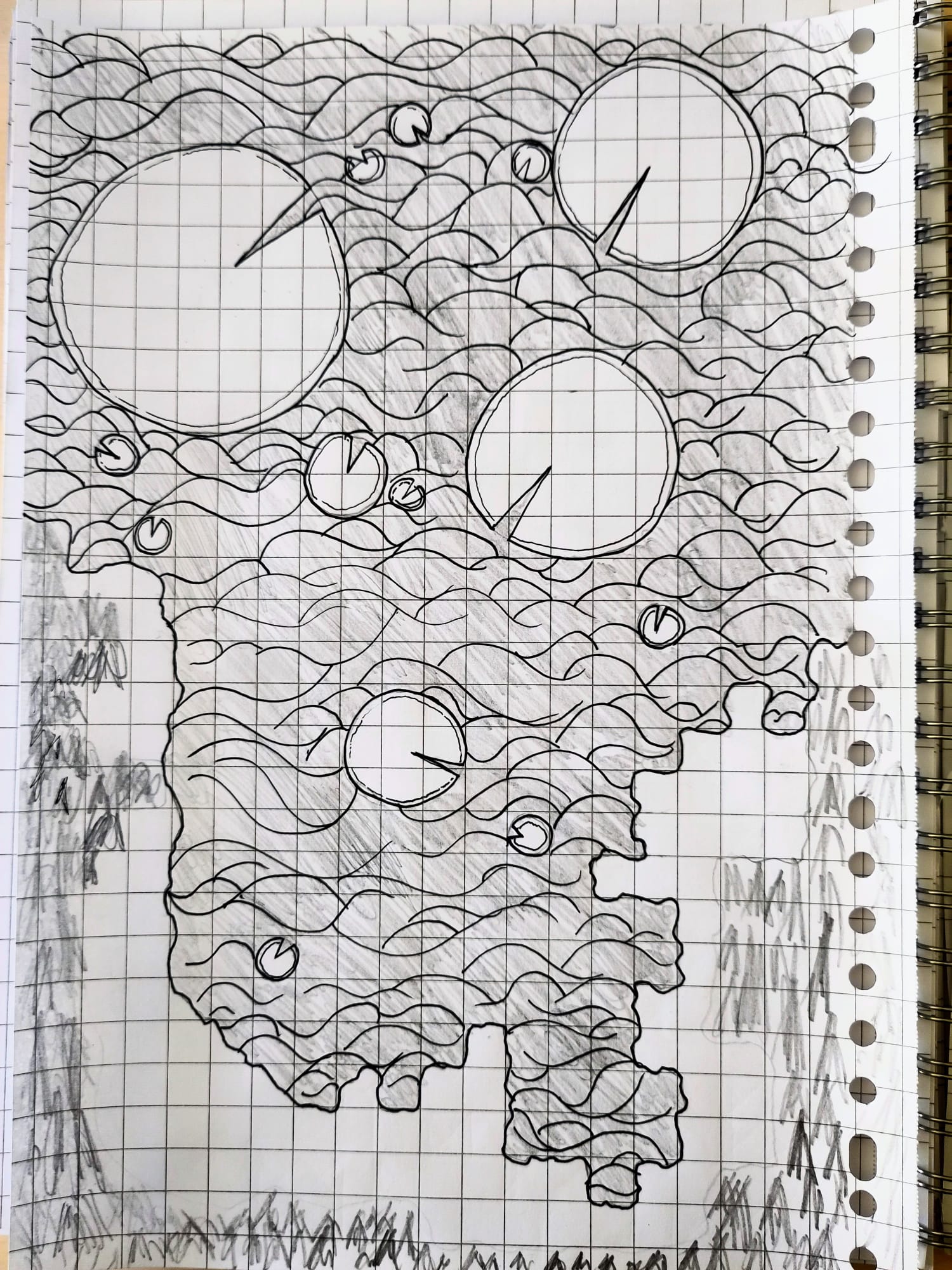
Let's set the toad's speed to 50 feet, and allow it to make that whole distance a jump. This allows it to leap to the 3x3 lily-pad on its first turn, and lead the players on a merry-go-round chase along the three big northern pads at the top of the page in the rounds thereafter. If need be, it can also leap back onto the shore. It could technically leap into the water, and make the players always have to wade through difficult terrain to reach it, but that's not the challenge we want. We'll incorporate a behavioral clause into its stat block.
The lily-pads are spaced in such a way that you can jump between some them with a Strength score of 10, but only along certain paths. Strength score 15 allows you to jump 3 squares rather than 2, which gives you more freedom. Still, it's not enough to outmaneuver the toad.
As it stands, the toad will just barely be able to stay out of reach of melee PCs that are using the dash action to close with it. To actually catch up, the players will need to lock down its movement or boost their own with their cool spells and abilities.
The Players' Options
The fight is balanced for 3rd-level players so they'll likely have access to a few relevant spells and abilities. Misty Step is a classic, and Web is another good one. Another way to win is to blow the toad to smithereens with high ranged damage, in which case the 'get into melee' race is not as relevant. That's okay—because they're still thinking about what to do when you can't close with an enemy—and the melee fighters who need this lesson most will probably try to get adjacent no matter what. Melee range is where all their cool abilities happen!
It does bring up a useful point for later, though; we should be giving the toad some sort of attack that challenges the back rank. Maybe it can place areas of obscurement on the map, so that ranged PCs will need to move around every turn to get a clear shot.
Now, what if the players genuinely don't have any good movement abilities? They could have a party composition that lacks a their speedy team members—a real option in my case depending on who shows up tomorrow. They might also have expended all their teleports and entangle-vines in a previous encounter. In that case it might be nice to have a fallback option. I could place a few pickup items throughout the arena.
Pus Nodule. A bladder of black bile; some sort of parasite that grows on the lily-pads. Can be picked up as a free action.
When you take the Attack action, you can replace one of your attacks with throwing a Pus Nodule. Target one creature or object you can see within 20 feet of yourself, and make a ranged weapon attack roll using Strength or Dexterity. On a hit, the target takes 1d6 damage and gets covered in goo that gives it vulnerability to fire damage until the end of your next turn.
It's probably worse than what the player could have done in melee, but it can increase the party's damage output by a lot if they synergize. I don't know if I'm going to place these; it might also be okay to let them lose and realize that there's a gap in their combat capabilities. I'll decide based on the vibe at the table. If I were making a published product, this is probably something I'd want to figure out in playtesting.
Show Me the Toad Already
You're right, let's design this baby.
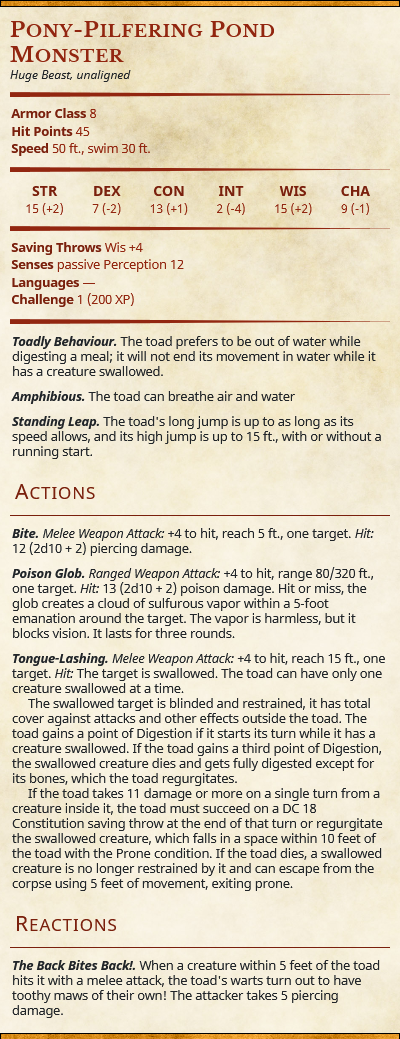
AC: Low because we want the melee players to have a high chance to hit once they do catch up to the toad.
Hit Points: Multiple metrics and calculations all suggest that the average party of three LV3's should be able to do 45 damage in three rounds. That means that the players will kill the toad in time if they manage to keep up with it (and maybe bust out a few of their limited high-damage moves).
Saving Throws: We want to keep these pretty low so that the toad is susceptible to effects like Entangle and Grease that make it easier to catch. We did put Wisdom a bit higher to steer away from abilities that could end the combat super fast, like the Sleep spell. We're not taking those options off the board entirely, but we want a little more friction there.
Toadly Behaviour: This is just a note to keep the toad from camping in the water, as discussed earlier.
Poison Glob: This is how we challenge ranged PCs to move around as well.
Tongue-Lashing: And here we have the main course. I loved the kraken's 'if they deal damage from the inside it may force the toad to regurgitate' rider, so I stole that and adapted the math to the toad's Constitution score and a high damage number that a player could realistically reach in this scenario. I'm not planning to have the horse making attacks from the inside, but this could be cool if the toad happens to swallow a player. The victory condition is 'the toad is dead,' so a player could get swallowed if the horse is regurgitated before either it or the toad die.
The Back Bites Back: The toad isn't a super high damage dealer for a solo encounter at 3rd level, and most of its attacks will be against ranged PCs. This means it can drain some more resources before the players reach whatever boss or final confrontation they're on their way towards—it mostly serves for the balancing of the long-term adventuring day.
Starting the Encounter
I'd have the player closest to the horse, the to-be-swallowed NPC, or the water make a Perception check before the battle starts. On a failure, the toad surprises the players and automatically succeeds at swallowing its target on its first turn. On a failure, the players are not surprised and get a chance to stop the swallowing altogether. I'd still have the toad automatically succeed at swallowing its first NPC target. There's a balance to be struck between letting the rolls steer the story and ensuring that the encounter can teach what it's supposed to teach.